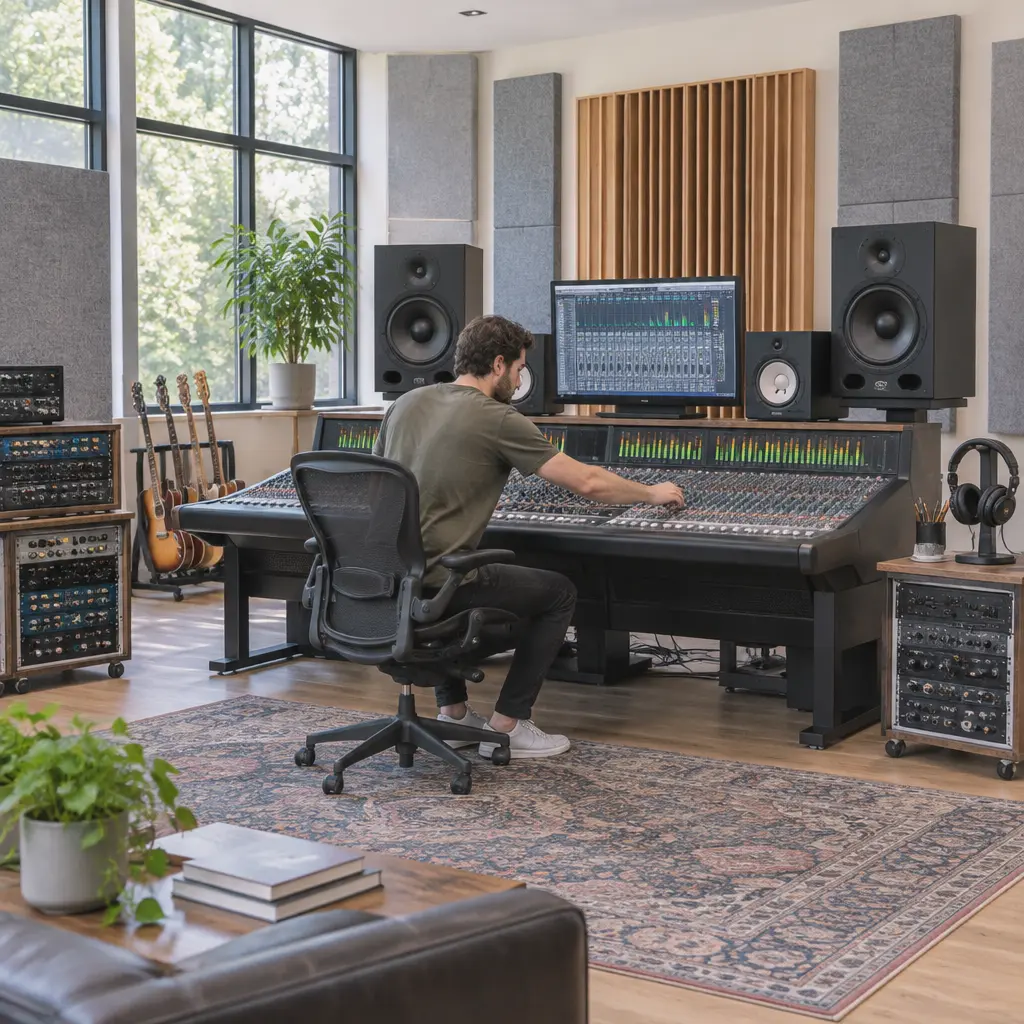
First-reflection-point treatment is the use of strategically placed absorptive panels where sound travels from studio monitors to a listener’s ears after bouncing off nearby surfaces. In a home studio, treating these points before buying bass traps is often a sensible first step: it can reduce distracting early reflections and improve stereo imaging, while bass treatment addresses a different problem—low-frequency buildup and uneven response. Neither step replaces the other, and the right order depends on room measurements, listening tests, and the room’s size and construction. Acoustic guidance from organizations such as the Audio Engineering Society and the National Research Council emphasizes that room boundaries and reflections affect what listeners hear; practical priorities include setting up the listening position, identifying reflection paths, treating those paths with suitable broadband absorbers, and then evaluating bass behavior.
First-reflection treatment improves the home-studio listening environment
A first reflection is the earliest sound that reaches the listener after reflecting from a nearby boundary, commonly a side wall, the ceiling, or a desk. Because it arrives shortly after the direct sound, it can interfere with the perceived sound from the monitors, affecting tonal balance, clarity, and stereo localization. The exact effect depends on the delay, level, frequency content, and geometry; there is no single reflection time or treatment thickness that works for every room.
The distinction between reflection control and bass control matters. Absorbers placed at reflection points are generally intended to reduce mid- and high-frequency reflected energy across a broad area. Bass traps are designed to help manage low-frequency resonances and uneven bass response, which are influenced by room dimensions, boundaries, and speaker and listener positions. A thin foam panel may reduce some treble reflections but is not a substitute for effective low-frequency treatment. Conversely, bass traps do not automatically solve a strong side-wall reflection at the listening position.
Reflection-point identification guides first-reflection treatment
A reflection point is the location on a room surface from which sound from a monitor can bounce toward the listening position. The mirror method is a practical way to locate side-wall and ceiling points: while seated in the listening position, have another person move a mirror along the surface. Wherever you can see a monitor’s tweeter in the mirror is a candidate reflection point for that speaker. Repeat for both monitors and both side walls; use a similar approach for the ceiling, taking care to work safely.
This method is a geometric approximation, not a complete acoustic measurement. It helps locate direct reflection paths in the listening setup, but it does not quantify their strength or reveal room modes. Recheck the points if you move the monitors, desk, or chair. The listening position and speaker placement should be reasonably settled before installing panels, since changing the geometry changes the paths.
Side-wall reflection points
Side-wall reflections are among the most commonly treated because they can reach the listener from the left and right at different times and levels. Place broadband absorbers over the identified points, covering enough area to account for the speaker’s radiation and the listener’s head movement. Matched placement on the two sides is a useful starting point, although rooms are not always symmetrical and furnishings or openings can change the result.
Use panels with documented absorption performance rather than relying on appearance or a product label alone. The National Research Council’s work on room acoustics and ISO 354’s reverberation-room test method illustrate why absorption is frequency-dependent: a material’s performance changes across frequency bands. A panel that is effective at higher frequencies may absorb much less in the lower midrange.
Ceiling and desk reflections
A ceiling reflection can be identified with the mirror method and treated with a securely mounted broadband absorber, sometimes called a cloud. The panel should be positioned to intercept the relevant path while leaving adequate clearance and following safe mounting practices. In a low-ceiling room, the ceiling and desk can create closely spaced reflections, so treating only the walls may leave an audible problem.
The desk itself can reflect monitor sound toward the listener. Where practical, avoid placing the monitors so that the desk surface creates a strong path to the ears; adjust monitor height, tilt, and desk layout, then listen again. A soft desk mat may reduce some upper-frequency reflections, but it is not equivalent to a properly designed absorber and will not fix low-frequency room response.
Front-wall and rear-wall reflections
The wall behind the monitors and the wall behind the listener may also contribute reflections, but their treatment should follow the room’s geometry and measured behavior. The rear wall can be especially influential when the listening position is close to it. Depending on available space and frequency range, a combination of absorption, diffusion, or a change in listening position may be more suitable than simply adding thin panels.
A useful bridge from reflection treatment to bass management is to recognize that the same boundaries influence both. A wall can create an early reflection at mid and high frequencies while also participating in low-frequency modes. Treating one issue does not guarantee the other is controlled, so evaluate each frequency range separately.
Broadband absorbers and bass traps address different frequency problems
A broadband absorber is a porous or otherwise engineered panel intended to reduce sound energy over a relatively wide frequency range. Common examples include mineral-wool or fiberglass panels with a permeable fabric covering. A bass trap is a treatment intended to reduce excessive low-frequency energy; porous corner traps are one type, while tuned membrane or resonant absorbers are another. These categories can overlap: a sufficiently deep, well-installed porous panel may absorb some bass as well as reflections, but its low-frequency effectiveness depends on thickness, airflow, mounting, and placement.
There is no universal rule that reflection panels must always come before bass traps. In many small project rooms, however, treating clearly audible early reflections is a cost-effective first intervention because panel placement is relatively straightforward and can improve monitoring conditions without requiring a full room redesign. If the dominant problem is severe bass buildup, nulls, or long low-frequency decay, bass treatment and speaker-position experiments may deserve equal or earlier attention.
Panel thickness, air gaps, and coverage
Panel thickness and an air gap behind the panel can improve absorption at lower frequencies compared with a thin panel mounted flush to a wall, although the result depends on material properties and installation. Published absorption coefficients should be interpreted carefully: test results describe specific specimens and mounting conditions, not every product or room. Cover the reflection area rather than assuming that one small panel will control every path.
Prioritize safe construction and installation. Use appropriate framing, fabric, and mounting hardware; do not leave irritating fibers exposed, and ensure ceiling panels are securely supported. A larger number of inexpensive decorative foam squares is not necessarily more effective than fewer properly designed broadband panels.
When bass traps should move up the priority list
Bass traps deserve early attention when bass notes vary dramatically from one position to another, certain notes ring longer than others, or measurements show pronounced low-frequency peaks and decay. Small rectangular rooms commonly exhibit room modes—resonances shaped by room dimensions and boundary conditions. The lowest modes are not reliably controlled by thin wall foam, and placement changes can sometimes improve a listening position more than adding a small amount of treatment.
Corner placement is common for porous bass traps because corners are boundary junctions where low-frequency pressure can be high, but effectiveness is not guaranteed by location alone. Treating more corner area with adequately deep material generally offers a better chance of useful broadband absorption than using very thin panels. Tuned absorbers can target narrower frequency ranges, but they require careful design and installation.
Measurement and listening tests validate treatment decisions
Room treatment should be evaluated rather than purchased by guesswork. Begin with stable speaker and listening positions, then listen to familiar recordings at moderate levels. Notice whether phantom-center vocals remain centered, whether panned elements are easy to locate, and whether the tonal balance changes when you move your head slightly. These checks are useful, but listening impressions alone cannot identify every low-frequency issue.
Measurement software and a calibrated measurement microphone can help display frequency response and decay. Room EQ Wizard, for example, is commonly used by home-studio owners for acoustic measurements. Take measurements at the listening position and nearby points, because one measurement can conceal spatial variation. Frequency-response plots are not a complete verdict: measurement technique, microphone calibration, windowing, and room noise all affect the result.
A practical treatment sequence
- Set up the monitors and listening position, keeping the left-right arrangement as symmetrical as the room permits.
- Use the mirror method to identify side-wall and ceiling reflection points, and inspect the desk for reflective paths.
- Install or temporarily test broadband absorbers at the most significant points; compare the sound before and after.
- Measure bass response and decay at the listening position and nearby locations, then experiment with speaker and chair placement.
- Add suitable bass trapping where the remaining evidence indicates low-frequency problems, and remeasure or listen again.
This sequence is a starting workflow, not a fixed prescription. In a very small, untreated room with severe bass problems, low-frequency treatment may need to happen alongside reflection control. If the room has limited space or budget, moving the listening position, improving monitor placement, and treating the most consequential reflection paths can provide more value than buying products without diagnosis.
A balanced home-studio plan treats reflections before adding treatment blindly
First-reflection treatment is a practical early step because it targets identifiable sound paths that can interfere with monitoring and stereo perception. The mirror method helps locate side-wall and ceiling points, while broadband absorbers are more appropriate than thin decorative foam for meaningful broadband control. Bass traps address a separate challenge—low-frequency resonances and uneven response—and should be selected according to the room’s measured or clearly audible behavior.
The broader lesson is to treat the room as a system: geometry, monitor placement, listening position, boundaries, and absorption all interact. Before spending on bass traps, identify and address obvious early reflections, then test the result and investigate the low end. Use measurements where possible, make changes incrementally, and consult acoustic test data or a qualified acoustician when the room has persistent problems.
Sources: Audio Engineering Society, AES Standards and Publications on Acoustics and Audio Measurement, https://www.aes.org/standards/; International Organization for Standardization, ISO 354:2003 Acoustics—Measurement of sound absorption in a reverberation room, https://www.iso.org/standard/34545.html; National Research Council Canada, Acoustics and the Built Environment research, https://nrc-publications.canada.ca/; Room EQ Wizard, REW Room Acoustics Software, https://www.roomeqwizard.com/; Everest, F. Alton and Ken C. Pohlmann, Master Handbook of Acoustics, McGraw Hill, https://www.mheducation.com/highered/product/master-handbook-acoustics-everest-pohlmann/M9780071841047.html.