
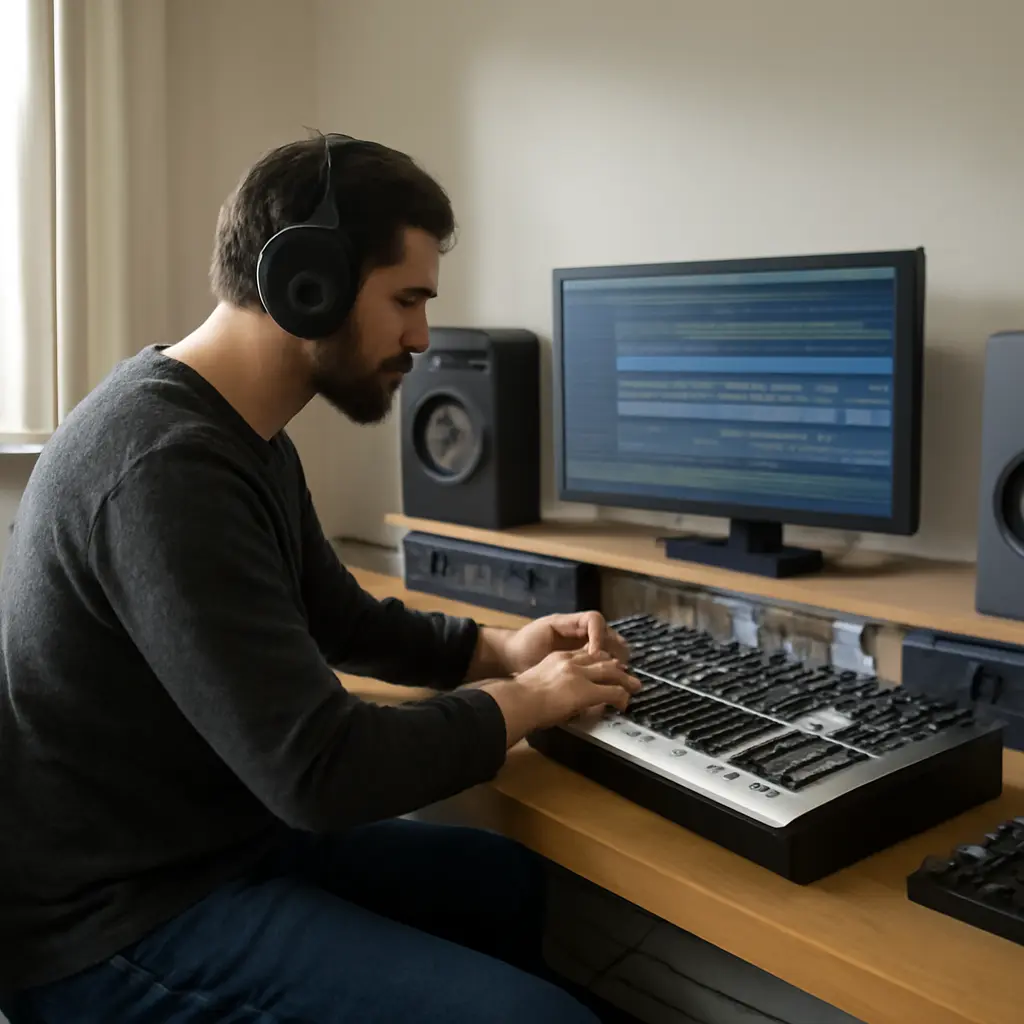
Electronic music feels good when its rhythm, sound design, dynamics, and emotional direction work together to create a satisfying physical and emotional response. There is no single formula: research suggests that musical pleasure can involve prediction, surprise, reward, and movement, while practical production choices—such as a clear low end, purposeful repetition, and contrast between sections—help translate those mechanisms into a track. This guide connects the psychology of musical pleasure with groove, sound design, arrangement, mixing, and a practical method for evaluating a finished mix.
Musical pleasure explains why electronic music feels good
Musical pleasure is the positive emotional response a listener experiences while hearing music, ranging from calm enjoyment to intense excitement. Neuroscientist Valorie Salimpoor and colleagues showed that intense musical pleasure can involve dopamine activity in the brain’s reward system. Their 2011 study, published in Nature Neuroscience, examined listeners who reported experiencing “chills” from music. The finding does not mean every satisfying track uses the same trick; it does support the idea that anticipation and emotional payoff matter.
Electronic music has particular tools for shaping that experience: precise timing, repeating patterns, controllable timbre, and large-scale changes in energy. These tools can make a listener feel grounded, energized, surprised, or emotionally released. The following subsections turn that broad idea into production decisions.
Expectation and surprise create musical reward
Expectation is the listener’s sense of what may happen next; surprise is the difference between that expectation and the musical event that follows. Repetition teaches listeners a pattern, while a variation—a missing kick, a new chord tone, or a brief fill—can renew attention. Music researcher Elizabeth Margulis describes repetition as a central way listeners learn and engage with musical patterns in On Repeat (2014).
In a club track, a producer might establish a four-bar bass phrase, repeat it, then alter its final note before a transition. The change works because the listener has learned the original. Too little variation can make a section feel static; constant novelty can prevent any idea from becoming familiar. Build a pattern first, then make changes that clarify its direction.
Movement links groove to bodily response
Groove is the perceived rhythmic feel that invites movement, even when the beat is not mechanically complex. In a 2006 study in Nature, researchers Jessica Grahn and Matthew Brett found that beat perception engages motor-related brain regions, supporting a connection between hearing rhythm and preparing movement. The finding helps explain why a steady pulse can feel compelling, but it does not prescribe one tempo or beat pattern for every genre.
A practical test is to listen away from the screen. If the kick, bass, and percussion make the body’s likely movement feel clear, the groove is communicating. If the rhythm feels stiff, try changing note lengths, accents, or the relationship between kick and bass before adding more percussion.
Groove and rhythm make electronic music feel physical
Groove is the way rhythmic events combine into a felt pattern of motion. It depends not only on tempo but also on timing, accent, duration, and the interaction of parts. A straight four-on-the-floor kick, a swung hi-hat, and a syncopated bass line are different rhythmic hyponyms: distinct approaches within the broader category of groove.
Tempo can provide useful context, but genre ranges overlap and should not be treated as rules. A 2020 analysis by Viberate of more than 1.5 million electronic tracks found substantial variation across electronic subgenres, illustrating that tempo alone does not define a style. The useful question is whether the rhythm supports the intended energy and movement.
Kick and bass establish the foundation
The kick is the low-frequency drum hit that commonly marks the pulse, while the bass supplies sustained or patterned low notes. Together they form the rhythmic and tonal foundation. If both occupy the same frequency and timing space without a clear relationship, the low end can sound blurred or overly forceful.
Start by deciding which element leads at each moment. A short kick can leave room for a sustained bass note; a bass pattern can pause on the kick’s strongest hits. Equalization, sidechain compression, and note arrangement are possible tools, but listening in context matters more than applying a standard preset. Check the balance quietly and on more than one playback system.
Swing and microtiming add character
Swing is a patterned shift in the relative timing of subdivisions, while microtiming refers to small deviations from a rigid grid. These choices can make drums feel relaxed, urgent, or human. The amount is style-dependent: a tightly quantized techno pattern may suit its purpose, while lightly shifted hats can create motion in house or broken-beat music.
Rather than moving every note by the same amount, adjust a few elements and compare. A shuffled hi-hat against a steady kick, for example, can create a lively contrast. Preserve the rhythmic anchor so that looseness feels intentional rather than inaccurate.
Syncopation and space create momentum
Syncopation emphasizes weaker beats or offbeats, creating tension against the expected pulse. Space is the deliberate absence of sound. Both can make a groove more engaging: a bass note landing just before a kick can pull the listener forward, while a brief drum dropout can make the next downbeat feel stronger.
Use these devices in proportion. If every part is syncopated, the main pulse may become hard to feel. If every measure is full, there may be no room for contrast. Try removing one hit before adding another; a well-placed silence is often more effective than a busier pattern.
Sound design makes electronic music feel vivid
Sound design is the creation and shaping of musical tones, textures, and effects. In electronic production, it may involve synthesis, sampling, filtering, distortion, modulation, and spatial effects. The sound-design choices that feel good are not necessarily the most complex; they are the ones that support the track’s mood and leave important musical roles easy to understand.
A warm pad, sharp pluck, noisy riser, and distorted bass are different sound categories, each with its own envelope, frequency profile, and sense of space. Organizing sounds by role—pulse, bass, harmony, melody, texture, and transition—helps prevent a session from becoming a collection of unrelated effects.
Timbre and envelope shape emotional character
Timbre is the quality that distinguishes one sound from another even when they play the same pitch. An envelope describes how a sound changes over time, commonly through attack, decay, sustain, and release. A short attack can feel immediate; a slow attack can feel soft or expansive. These are useful tendencies, not universal emotional meanings.
For example, a crisp pluck can mark a rhythmic figure clearly, while a slowly swelling pad can support a reflective section. If a synth sounds exciting in isolation but competes with the vocal or lead in the full arrangement, adjust its register, envelope, or level rather than adding more processing automatically.
Harmony and melodic motifs give listeners something to remember
Harmony is the relationship among simultaneous pitches; a motif is a short, recognizable musical idea. Simple harmonic material can feel powerful when its voicing, rhythm, and timbre are distinctive. A repeated two-note figure may become memorable through subtle changes in register or instrumentation, while a chord progression can communicate motion without requiring a complicated melody.
Test motifs at different points in the arrangement. A phrase that works in a breakdown may become tiring if it plays continuously over a dense drop. Vary its ending, remove it for a few bars, or let another sound answer it. This preserves recognition while creating room for development.
Effects create depth, movement, and contrast
Reverb simulates or creates a sense of space, delay repeats a sound over time, and modulation changes a sound’s characteristics periodically. Used deliberately, these effects can make a dry drum feel close, a pad feel distant, or a transition feel as if it is opening outward. Overuse can reduce clarity, especially when long effects accumulate in a busy mix.
Automate effects around musical events instead of leaving every sound permanently wide or reverberant. A short delay throw at the end of a phrase can highlight a note while keeping the main pattern focused. Compare the processed sound with its dry version so that the effect adds a useful dimension rather than simply more loudness or wash.
Arrangement and dynamics make electronic music feel rewarding
Arrangement is the organization of musical events over time; dynamics are changes in perceived intensity. Both shape the listener’s sense of expectation and payoff. Electronic tracks often use introductions, builds, drops, breakdowns, and outros, but these are options rather than mandatory sections. A compelling arrangement gives each change a reason to happen.
In a 2013 study published in Current Biology, music psychologist Vincent Cheung and colleagues investigated musical anticipation and reward, finding that uncertainty and prediction are relevant to pleasure. In production terms, a build can prepare a listener for a drop, but the payoff does not have to be louder: it could instead be a new harmony, a wider texture, or the return of a familiar motif.
Builds prepare the listener for change
A build is a passage that increases anticipation before a transition. It can use rising pitch, denser percussion, increasing filter brightness, or gradual addition of layers. The essential feature is directional change: the listener senses that the musical state is moving toward something.
Avoid making every build use the same riser, snare roll, and sudden silence. A small subtraction—a bass disappearing before the downbeat—can be as effective as a long crescendo. Make the transition legible, then give the next section enough contrast to feel like a genuine arrival.
Drops and breakdowns balance impact with relief
A drop is a high-energy entrance or return, commonly featuring the main beat or bass. A breakdown is a contrasting section in which some of that energy is reduced. Their relationship matters: a drop feels more powerful when the preceding section creates anticipation, and a breakdown feels meaningful when it changes the emotional or textural perspective.
Compare sections at matched playback levels when judging their arrangement. A louder drop can seem more exciting simply because it is louder, but a strong return should also be recognizable through rhythm, timbre, harmony, or density. Try changing one major dimension at a time to learn what creates the clearest payoff.
Repetition and variation sustain attention
Repetition builds familiarity; variation prevents familiarity from becoming monotony. In electronic music, variation can be as small as opening a filter, changing a percussion accent, or removing a note every eighth bar. Larger changes—such as introducing a new chord sequence—can mark a new section.
A useful editing question is whether each repeated element still contributes. If a loop remains unchanged for a long passage, consider subtle automation or a planned break. If every loop changes, restore a stable reference point so the listener can recognize the track’s central idea.
Mixing and playback help electronic music feel comfortable
Mixing is the process of balancing and shaping recorded or synthesized parts so they work together. A pleasant mix is not simply loud: it has a clear hierarchy, controlled low end, useful stereo depth, and enough dynamic contrast for its style. The World Health Organization’s safe-listening guidance recommends keeping exposure to sound levels and durations within safe limits; this is relevant because repeated loud playback can risk hearing, not improve a mix.
The exact technical target depends on the release format, platform, and genre. Rather than chasing one universal loudness number, make the arrangement and balance translate at sensible playback levels. The following checks are practical ways to do that.
Frequency balance keeps the mix clear
Frequency balance is the distribution of energy across low, mid, and high frequencies. Too much overlapping low-frequency energy can obscure the kick and bass relationship; excessive upper-mid energy can make a track fatiguing; insufficient high-frequency detail can make it feel dull. These problems are best diagnosed in the full mix, not by soloing every track indefinitely.
Use equalization to solve audible conflicts, not to force every sound into a preset curve. Compare the mix on headphones, speakers, and a modest playback device if available. A bass line that is audible only on large speakers may need clearer harmonics or a more defined rhythm, rather than simply more sub-bass.
Dynamics and loudness preserve impact
Dynamics describe changes in level over time, while loudness describes perceived sound intensity. Compression and limiting can control peaks and increase average level, but excessive processing can flatten transients and reduce the difference between sections. Retaining some movement often helps a drop feel powerful without making every moment equally intense.
Take breaks during long sessions and avoid making critical decisions only at high volume. The WHO’s safe-listening recommendations emphasize managing both sound level and listening duration. Protecting hearing is also a production advantage: rested ears are better able to judge balance, distortion, and fatigue.
Mono compatibility and translation reveal mix problems
Mono compatibility is the ability of a stereo mix to retain its essential elements when the left and right channels are combined. Wide effects can create spaciousness, but phase interactions may weaken sounds in mono. Checking mono playback can reveal a bass, vocal, or lead that disappears or becomes unusually thin.
Also listen at low volume. If the kick, principal motif, and vocal become indistinct, the mix’s hierarchy may rely too heavily on loudness or exaggerated high frequencies. A translation check is not a demand that the track sound identical on every device; it is a way to ensure its most important musical information survives.
A practical workflow helps make electronic music feel good
A workflow is a repeatable sequence of decisions that helps a producer move from an idea to a finished track. It should preserve experimentation while making evaluation manageable. The steps below combine the article’s main concepts into a straightforward process.
- Choose a feeling and a reference. Describe the intended response in plain language—such as warm, driving, playful, or spacious—and select a reference track for balance and arrangement, not imitation.
- Establish the groove. Build a kick, bass, and one or two supporting rhythmic parts. Test the pattern by listening and moving, then adjust accents, note lengths, and timing.
- Create a memorable idea. Develop a motif, chord texture, or distinctive sound that gives the track an identity. Keep its role clear in the mix.
- Arrange with contrast. Use repetition to establish expectations and selective changes to develop them. Make builds, drops, and breakdowns serve the track rather than follow a template automatically.
- Mix in context. Balance parts, resolve frequency conflicts, and use effects to create space or motion. Check the mix quietly, in mono, and on different playback systems.
- Take breaks and get feedback. Return with fresh ears, ask listeners what they remember or feel, and revise the musical cause of a problem before adding more processing.
A useful evaluation chart can track four dimensions after each listening pass: groove, emotional clarity, arrangement contrast, and playback comfort. Rate each from 1 to 5, then write one specific observation—for example, “the bass masks the kick in the drop.” This is a listening aid, not a scientific measurement, but it turns vague reactions into actionable revisions.
Conclusion: make electronic music feel good through intention and contrast
Electronic music feels good when musical pleasure, groove, sound design, arrangement, and mixing support the same emotional aim. Research on reward and rhythm helps explain why anticipation, pattern, and movement can matter; production practice shows how kick-and-bass relationships, timbre, motifs, contrast, and careful playback checks can turn those ideas into a coherent track.
There is no universal tempo, sound, or loudness setting that guarantees a satisfying result. Build a clear groove, give listeners something to recognize, vary it with purpose, and protect enough space for changes to register. For further exploration, read the cited research on musical reward and rhythm, then test one production choice at a time in your own sessions.
Sources: Salimpoor, Valorie N., et al., “Anatomically distinct dopamine release during anticipation and experience of peak emotion to music,” Nature Neuroscience, 2011, https://doi.org/10.1038/nn.2726; Margulis, Elizabeth Hellmuth, On Repeat: How Music Plays the Mind, Oxford University Press, 2014, https://global.oup.com/academic/product/on-repeat-9780199990825; Grahn, Jessica A. and Matthew Brett, “Rhythm and beat perception in motor areas of the brain,” Nature, 2007, https://doi.org/10.1038/nn.1951; Viberate, “Electronic Music Genres: A Data-Driven Overview,” 2020, https://www.viberate.com/blog/music-analytics/electronic-music-genres/; Cheung, Vincent K. M., et al., “Uncertainty and surprise jointly predict musical pleasure and reward value,” Current Biology, 2019, https://doi.org/10.1016/j.cub.2019.09.045; World Health Organization, “Safe listening,” https://www.who.int/news-room/questions-and-answers/item/healthy-lifestyles-safe-listening.


